Ghostwriting, Editing & Bylines
”Andrew’s editorial and copyeditorial work is both speedy and accurate, and he’s committed to preserving and enhancing the vision and voice of any author he works with.”
—James Waller, Editorial Director, Thumbprint;
Adjunct Professor, Tandon School of Engineering, NYU
Bibliography


I can write about anything, in any style, for any audience, in any voice. An editorial generalist, I have ghostwritten, doctored, copy edited, and edited over 80 books—from textbooks on architecture to oral histories of heavy metal music to a slim volume about bespoke golf courses. l even contributed to a bartending guide.
My clients include Random House, Simon & Schuster, Hearst, HarperCollins, Wiley, Macmillan, and St. Martins, as well as boutique publishers and academic presses.
Ghostwritten blog posts
People don’t write the way they speak, and finding the right voice when ghostwriting involves more than cleaning up an interview transcript. During an interview, I get a sense of the subject’s personality and their perspective on the topic at hand. Afterward, I review any posts they’ve authored and videos in which they appear. I then filter the transcript of my interview through the lens I’ve been able to develop to create a post in the “author’s” unique style. (You can find another ghostwritten blog post here.)

Why AI is the new engine for retail marketing
Retailers run on razor-thin margins—a reality every retail marketer knows. It’s a challenge faced by the owners of your corner bodega and by the CEOs of the largest, most successful brick-and-mortar retailers in the world.
But retailers are also among the most nimble marketers: According to GrowthLoop’s 2025 AI and Marketing Performance Index, 76% report marketing campaign cycles of fewer than 30 days, and 13% have compressed those cycles to under a week, outpacing their counterparts in every other industry by as much as 225%.

Marketing isn’t a race to the finish line, however, and faster alone doesn’t necessarily mean more profitable. Retail marketers have at least one thing in common with their slower-but-steady colleagues in tech, media, manufacturing, and finserv: They all list bottlenecks in data collection, reporting, and analysis as one of the biggest obstacles to turning rapid marketing cycles into growth marketing cycles.
Marketers in retail, e-commerce, and consumer goods are also the most likely to single out artificial intelligence as the best way to uncork those bottlenecks and turn data into the real-time insights and predictions needed for faster, more fruitful campaigns.
Without the right strategy, data is noise
AI is a tool your competitors already wield. But your first-party data is a differentiator. While AI best-practices are key to an AI-supported marketing strategy, AI is only as good as the data underlying it. So having the right data strategy is key—especially for retailers.
The best data strategies begin with an enterprise data warehouse containing a 360-degree view of your customers that goes beyond demographic information and includes data unique to your relationship with each one of them. Purchase and channel-specific engagement histories are examples of customer data that are discrete to every organization. Continue reading on the GrowthLoop Blog >>

Finding a great restaurant has never been easier with Biter app and Google Maps Platform
by Daniel Kohanof
Co-founder, Biter
The omnivore’s dilemma
If you’re a foodie like me, when your stomach starts to growl, the question you ask isn’t whether to go out to eat, but where. We developed Biter to make it easier to find a great restaurant—wherever you are, no matter what type of food you’re hankering for. And we used Google Maps Platform to make it easier and faster to build an accurate, trustworthy app.
Biter centralizes restaurant recommendations from your friends and favorite food influencers, and lets you record and share your own reviews of the places where you’ve eaten. If an article, photo, or video about food can be shared from its native location—whether that’s TikTok, YouTube, The Infatuation, or The New York Times—you can add it to your Biter hitlist or favorites. Then click a button, and Google Maps tells you how to find the restaurant, when it’s open, and how to reserve a table. You can even browse restaurants by neighborhood and cuisine and find out what the food’s like from people you follow and trust.


Either way, Biter puts good food at your fingertips—even if you’re eating with a fork, knife, and spoon—by curating information about a restaurant from disparate sources automatically. No more hopping between social channels and food websites, hunting for bookmarks, or searching through texts from your foodie friends. When you’re really hungry, every minute counts, and Biter gets you to the perfect restaurant faster.
Technology, tools, and services for a two-man startup
As a small startup, we needed a platform with a powerful, geolocation-enabled search engine and maps that are accurate and serve up-to-date multimedia content so we didn’t have to build out that functionality ourselves. Google Maps Platform ticks all the boxes. It enabled us to develop and launch Biter in just four months because many of the baseline features the app requires already exist through Google Maps Platform.
The Places API powers the fundamental Biter user experience. That includes searching for nearby restaurants, displaying publicly available information about them, locating them on a map, and serving up the content on Biter about them. The network of restaurants available through the Places data is far more comprehensive than any we could purchase or develop ourselves, and Google Maps is updating in near real time because most restaurant owners actively manage their Google profiles. Continue reading on the Google Maps Blog >>

This migration from Snowflake to BigQuery accelerated model building and cut costs in half
by Russell Foltz-Smith
Executive Vice President, Product & Technology, SmarterX
In 2024, retail sales for consumer packaged goods were worth $7.5 trillion globally. Their sheer variety—from cosmetics to clothing, frozen vegetables to vitamins—is hard to fathom. And distribution channels have multiplied: Think big box stores in the brick-and-mortar world and mega ecommerce sites online. Most importantly, jury-rigged digital tools can no longer keep pace with the ever-growing web of regulations designed to protect consumers and the environment.
SmarterX uses AI to untangle that web. Our Smarter1 AI model aggregates and triangulates publicly available datapoints—hundreds of millions UPCs and SKUs, as well as product composition and safety information—from across the internet. By matching specific products to applicable regulatory information and continuously updating our models for a particular industry or client, SmarterX helps retailers make fully compliant decisions about selling, shipping, and disposing of regulated consumer packaged goods.
And just like our clients, we needed to accelerate and expand our capabilities to keep pace with that data deluge and build better AI models faster. Migrating to Google Cloud and BigQuerygave us the power, speed, and agility to do so.


Embracing BigQuery: A flexible, easy-to-use, AI-enabled data platform
Because we deal with data from so many sources, we needed a cloud-based enterprise data platform to handle multiple formats and schemas natively. That’s exactly what BigQuery gives us. Since data is the foundation of our company and products, we began by migrating all our data—including the data housed in Snowflake—to BigQuery.
With other data platforms, the data has to be massaged before you can work with it: a time-consuming, often manual process. BigQuery is built to quickly ingest and aggregate data in many different formats, and its query engine allows us to work with data right away in whatever format it lands. Coupled with Looker, we can create easy-to-understand visualizations of the complex data in BigQuery without ever leaving Google Cloud.
In addition, because Gemini Code Assist is integrated with BigQuery, even our less-technical team members can do computational and analytical work. Continue reading on the Google Cloud Blog >>
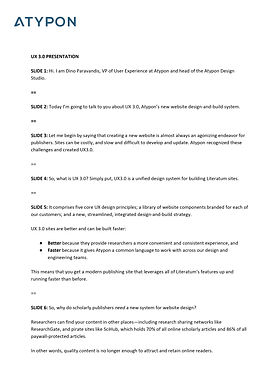
Ghostwritten presentation script
At a multinational company like Atypon, many conference presenters’ native language was not English. Others were unused to public speaking. In addition to providing a presentation coach and conducting rehearsals, I wrote conversational scripts in each presenter’s voice to help those presenters feel more secure in their delivery.
This one accompanied the launch of our design studio, which was given separate branding to distinguish the company’s platform from its services offerings. A VP at the company, the speaker wanted to sound authoritative but also approachable. (The text is keyed to the slides in the deck.)
You can find thought leadership articles I’ve ghostwritten here, a blog post I ghostwrote for the co-founder of a tech startup here, and examples of my branding work here.

Software documentation
_Page_01.jpg)
Bylined work

Lectures

%20_NYU_Page_01.jpg)
I’ve taught courses in software and product documentation, journalism, and marketing writing at NYU’s engineering school. The biggest challenge was to get engineers to think and write about how people would use their products rather than how they had been built. I taught coders to write procedural as well as reference documentation, and engineers to write about product benefits rather than how the parts fit together. Each course always began with creative writing assignments to move students beyond their fear of writing, and critical thinking exercises to show them that even technical and business writing has sociopolitical implications.